

Reflections on Change
What autumn leaves and a therapy model can teach us about changing


I’ve been thinking a lot lately about change. Perhaps it’s because of the seasonal shift (or maybe lack thereof). Maybe it’s because of everything this year brought. Or it could be because a new year is around the corner and advertisements and influencers are already telling people all the things they ought to do differently. *sigh* Most likely, it’s a little bit of all of these, but also probably because change is what I do.
Something like 25 years ago, I was taking courses on curriculum design and teaching methods - and though I haven’t used them in the ways I expected, I’ve now been training and teaching for nearly 20 years. 2025 marked 15 years that I’ve been in the mental health field in various capacities and environments, including many that also involved teaching. I never really planned to focus on individual therapy when I started out, nor did I expect to start a business or open a private practice. But that’s the thing about plans and life….you actually never know what’s just around the bend.
My life today is largely unrecognizable to the one I was living 10 years ago, and that life was unrecognizable to the one I had been living 10 years before that. Some of the events and dynamics that contributed to these major shifts were choices, and others have been circumstances beyond my control. Even many of those that were “choices” were not preferences so much as necessary when it became apparent that no amount of wishing, striving, begging, praying, hoping, or waiting were going bring me the happiness, security, joy, and peace I wanted and deserve/d. Multiple times, I’ve had to admit that things were not as I had envisioned they would be…and in some cases, they were also not everything I’d been trying to convince myself and others they were.
You see, change rarely happens all at once. It can seem like it happened out of nowhere, but often it just looks that way to someone who catches a glimpse at the right moment. In actuality, it’s probably been growing over time by way of many micro-changes that build on each other over time. Small cracks. Then consecutive cracks. Gentle (or not so gentle) nudges. Lingering doubts. Tidbits of new information. Growing dissonance. Sleepless nights. Dreaming of possible alternatives. Daring to examine what these could look like. All these often happen under the surface for a long time before a change breaches the surface and becomes visible or actionable.
I often think about the Stages of Change used (among other places) in the therapy model called Motivational Interviewing. It’s perhaps the closest thing I have to a Roman Empire (to use a probably outdated cultural reference). Now, I don’t think any model is perfect, and I tend to Frankenstein bits and pieces of various models together rather than use them with their intended fidelity. But I will say this for Motivational Interviewing: it’s a model I’ve not had to completely unlearn or drastically alter as I’ve spent nearly a decade deconstructing the Western medical models of mental health and adapting approaches to be less harmful and more realistic. (More on that process another time…)
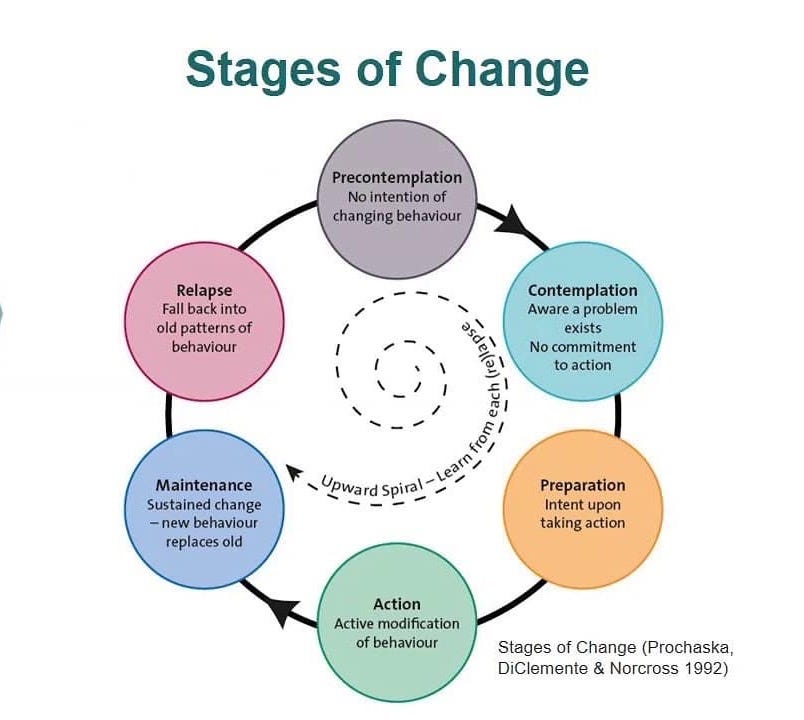
One of the things I’ve found most helpful – and accurate – is that the Stages of Change model recognizes there are distinct places that people can be at as they consider and plan for change. And in each of these places, what someone needs to be motivated to move to the next stage is totally different from the others. This is why I bristle a little when I see well-intentioned change-makers hammering messaging that’s misaligned with their audience.
For example, let’s say the goal is to get someone to adopt a new behavior because a current behavior is harmful, but that person is currently in a pre-contemplative stage where they don’t even acknowledge a problem exists, let alone have any interest in addressing said non-existent problem. In this stage, any communication like “here’s what you need to do right now to change your behavior” will typically fall flat (if not be met with animosity) because that’s 2-3 stages ahead of where the person is. For their stage, the goal actually needs to be help them consider whether they see the problem as a problem. If they eventually do, the next goal would be to have them consider what they want to do about it, then plan for how to do that, etc. Now, if that person has already moved through these stages and is preparing to make this change but is uncertain how to do it, or has started taking action but it’s tenuous, that same messaging of “here’s how to do it” is much more likely to take root because the soil has already been laid and tilled.
When change is cultivated with intention, lack of judgment, consideration, and alignment with someone’s values, there’s a much higher chance that it can come to fruition.
[Quick sidenote: this is likely a complete bastardization of this model and not at all what the people who develop it intended, but I think it’s a helpful exercise to notice how this shows up in advertising and propaganda. Both are typically very good at rushing people through these stages, usually through triggering and manipulating emotions like insecurity, anxiety, loneliness, or fear. Next time you see an ad or hear someone with an agenda speak, notice if they are shoe-horning in the creation of a (possibly non-existent or red herring) problem, followed by an emotional hook or dilemma, then selling you the solution which promises to resolve the feelings if you ACT RIGHT NOW!]
While the Stages of Change model is often used in substance use work and therapy, I’ve seen it be applicable to most types of behavior change. And though it’s a model often used by professionals to support individuals seeking help, I think it can be a valuable tool for evaluation and compassion, all around. It’s so common for people to get harsh and critical of themselves and others for what they are NOT doing. “Why can’t I just…?! Why aren’t they already…?!” Sometimes, realizing our current expectations are not aligned with the relevant stage can ease some of the friction and judgment, which often leads to a higher chance of that desired growth and change in the future.
When people consult with me about how to be influential - in their own lives or with others - the conversation often includes conceptualizing change-work as planting and watering seeds. This has been one of the most helpful metaphors and principles I’ve found to stay aligned in how I approach my work. Way back in my VERY early days as baby counselor working in hospital-based environments, I initially got very attached to outcomes and bought into the insurance-based medical model/ableist productivity expectations that “recovery” should be happening quickly and right before our eyes every day! I got exceptionally anxious and worried I was doing something wrong when people would relapse or not improve as outlined by insurance companies, who would often only approve a certain number of days of treatment. With some mentorship, I realized that the time frames and other expectations laid out for us were often unrealistic, or that people would need to continue their process after they left us. We would do our part to till the soil and plant some seeds, but we often would not know whether or how much those seeds would end up growing.
Admittedly, getting to see these seeds grow and bear fruit is part of the reason I eventually decided to move into individual therapy. It’s also why I love teaching.
I’ve been told by people who have attended trainings how much their mind has been opened to new possibilities in just a couple hours after simply being exposed to new ideas and information, in effective ways and at aligned times.
I’ve watched many people have “a-ha” moments when seemingly unrelated or vague impressions that have been swimming around on the periphery of their psyches suddenly crystalize with new clarity…sometimes with relief, other times with grief. Often with both and complex other feelings.
I’ve heard from countless others (and felt myself) how discouraging it can be to “still be facing a certain struggle or uncomfortable feeling when we’ve expected it to be resolved by now.
I’ve noticed a tone of surprise from folks when they realize that time does not, in fact, heal all wounds after all, and sometimes we have to be more intentional in how we address what is festering to heal the actual pain.
I’ve seen how straight-forward and simple change can sometimes be when people have access to various resources and supports, or when circumstances are aligned in their favor…and I’ve seen how critical people can be when they compare those examples to themselves or others, despite the vastly different context, wondering why it seems so hard for them when it’s so easy for others.
The reality is change is messy, complex, and far more nuanced than most of us would like. Change will look different depending on the person, situation, context, and numerous other variables, some of which we may never fully understand or see.
I’m reminded of this every year in the autumn (which I’m trying hard to maintain as my favorite season, despite that fact that Long COVID has made me a human barometer and it’s changed my relationship with the fall). Back in autumn of 2013, when I was newly in the throes of divorce, I spent a lot of time outside in nature. It felt very grounding and supportive while my life, much of my identity, nearly all of my social circle, and the future I’d imagined were crumbling under and all around me. I remember hiking in a forest preserve alone, intermittently crying and wondering how I could ever possibly start over. I could not imagine the amount of time, money, effort, emotional healing, and planning it would take to come back from that place.
Then I noticed the changing leaves. Of course the fact that the leaves change in the fall wasn’t new to me, as a life-long Midwesterner, but a couple things resonated differently for me that day, and they’ve stayed with me since.
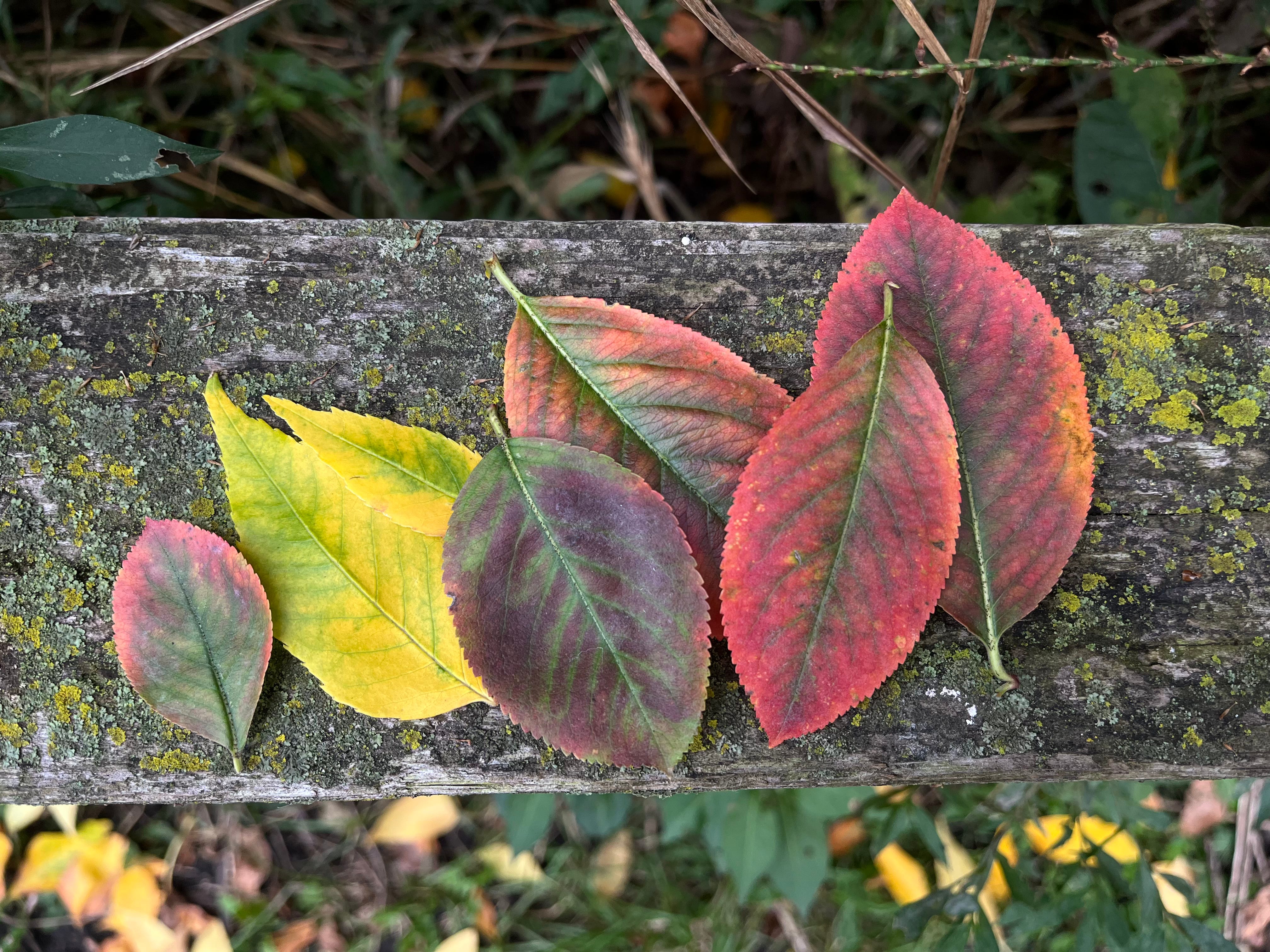
Yes, in the autumn leaves change colors and fall off the trees…but that’s not the end. It’s actually not even death, even though we might assume this from the shriveled leaves that dry up and crunch beneath our feet. The changing shades and dropping of leaves is actually a form of “self-protection”. The leaves have served their purpose of photosynthesis during growth season, but they won’t survive the brutal winter ahead, and tree’s energy is better spent redirected elsewhere. The spent leaves also put the trees at risk of harm if not dropped, as collected snow could be too much weight for the branches to bear. The linked Britannica article above goes on to say, “Dropping them gives the plant a fresh start in the spring, and the nutrients from the decaying leaves are recycled to help grow the next leafy generation.” (This is an invitation to save yourself the labor of raking and to let your leaves lie so they can feed the soil and provide housing for wildlife and pollinators.)
The changing colors of leaves is also not nearly as uniform as I had long-believed it was. Perhaps this impression was made by early childhood art projects with simple single-colored leaves, but some part of my brain had developed an image of green leaves that turn their respective red, yellow, or orange, before dropping and all turning brown. When I actually paused to notice the process, I realized this is far from the truth.
Leaves in the process of change are often multiple colors, and you can sometimes see where the chlorophyll has started to break down first, no longer masking the pigments that have been there all along. In other cases, new chemical processes that are unique to the cooler, post-growth season, cause new colors to be produced. I’ve also noticed how certain spots on a tree will sometimes change color dramatically before the rest of the tree even looks like it has started. This is due to things like how much light different parts of the tree get, and how much warmth different parts are exposed to.

Understanding the seasonal shifts and many complex factors that contribute to the speed and ways that leaves change has made me consider the process of change differently. I can’t imagine looking at different leaves from different trees with different environmental exposures and thinking, “Wow, that leaf is doing it all wrong.”
Does it make sense to judge someone for not conforming, or for not changing in the exact same way or at the same time as compared to someone else? Doesn’t it make more sense to consider how much someone’s genetics, environment, access, and presence/lack of nurturing influence affects their growth and change?
What would be possible if, instead of seeing change as a singular event with one model or goal, we understood change as something that happens over time, in many different ways, and with multiple possible outcomes that contribute to and influence larger change in a broader context?
What if we understood that change is often happening, even when we don’t always see it?
What would be different if we understood and accepted that not all change is beautiful, like the autumn leaves, but is often ugly, painful, and grueling?
What if, when it comes to change, we cultivated acceptance and appreciation for the messiness and nuance that…
sometimes we do need to work really hard at changing, and it will require significant discomfort and sacrifices?
and sometimes we’re better off doing less and trusting that the season will elicit change or planted seeds will grow with some patience?
and sometimes, we even have to accept that the change we want isn’t likely on our timeline, and need to adjust expectations and strategies accordingly?
and often there is wisdom in understanding that all of these are valuable in their own way, and sometimes the best we can do is aim for discerning which a situation is calling for?
If you’re someone who is working on adjusting your relationship to change and are looking to replace harsh New Year’s Resolutions with more gentle, aligned intentions, I’m extending the invitation to join me at my New Year’s Day Reflection Workshop this Thursday from 1:00-2:30pm/Central. Because I’m posting this much later than I had hoped, I’m extending the registration through 12 noon/Central tomorrow, Tuesday, December 30.
This will be a cozy, low-spoons, introvert-friendly, and mostly self-contained affair. Cameras are welcome to be on or off, and the majority of the time will be spent on guided journaling with reflection prompts. Registration info and link below!
A quick note of thanks for everyone who has supported me via Misfit Mental Health in 2025! I haven’t been able to keep up with all the writing and other things I’d like to do, because Long COVID continues to dictate so many aspects of my life. However I am heartened to have:
added nearly 1,500 subscribers this year!
reached 11 paid subscribers here on Substack!
had nearly 150 people buy me a coffee/tip me over on Ko-fi!
have had nearly 50 people register for/participate in workshops!
This support, engagement with my work, and financial support is very much appreciated - and is growing in importance, as I near 6 years of Long COVID limiting my ability to work. Please know I am grateful for your presence, sharing of my work, and all the comments I might not always respond to.
Current Offerings…
Registration is open for my New Year’s Day Reflection Workshop. Paid subscribers, Ko-fi supporters, and clients can email info@misfitmentalhealth.com to request a code for 20% off the standard registration fee. Register by 12pm Central tomorrow! If you can’t make this, a self-paced guide will be available in my Ko-fi Shop soon!
Now scheduling 1:1 Coaching for anyone facing major changes or life transitions,
but especially for zebras, canaries, black sheep, and other misfits looking for support navigating the often unforgiving realities of the world at large, including healthcare and other inflexible systems. Unlike therapy, there are no licensing or location restrictions, and no diagnosis or insurance oversight necessary.Consultation is available for mental health and other professionals who work with - or belong to - the chronic illness, dynamically disabled, neurodivergent, COVID Conscious, and other non-conforming communities.
What I’ve Been Up To…
I was recently quoted in a Medscape article on how Long COVID patients are using alternative and adjunctive treatments. I hope to write more on this topic soon, as there loads more to say about this complex topic!
In November, I spoke with some new friends at the Vestibular Disorders Association (VeDA) and Unfixed Media for their podcast ICU - “I See You” where we talked about the benefits and challenges of pacing. The recording is live now!
If you’re interested in learning about pacing - either for yourself, or to support a loved one, client, community member, employee, etc. - I’ve added a page dedicated to pacing on my website! This includes a link to my Pace Yourself workshop, which is now available on demand. I hope to add more resources to this page, as capacity allows.
As long COVID caused me to have to pivot from a social work admin career to therapy/coaching, your post is really timely for me and helps me deal with this beginner’s feeling that I’m not doing enough for my clients. I’m loosening my grip on that as I get more comfortable, and this post helped me reflect more on that. Thank you!